
Search Posts
ERPCorp SAP FICO Blog
- Hits: 18470
By John Jordan
RISE with SAP helps organizations modernize their existing SAP ERP landscape and move toward cloud ERP. Its potential benefits include a managed cloud foundation, structured transformation guidance, and a cleaner approach to adopting new capabilities.
For Finance and Controlling teams, the practical question is how that transformation will support reliable accounting, costing, reporting, and closing processes.
Read more: RISE with SAP Benefits: Cloud ERP Transformation Explained
- Hits: 60662
By John Jordan

Introduction
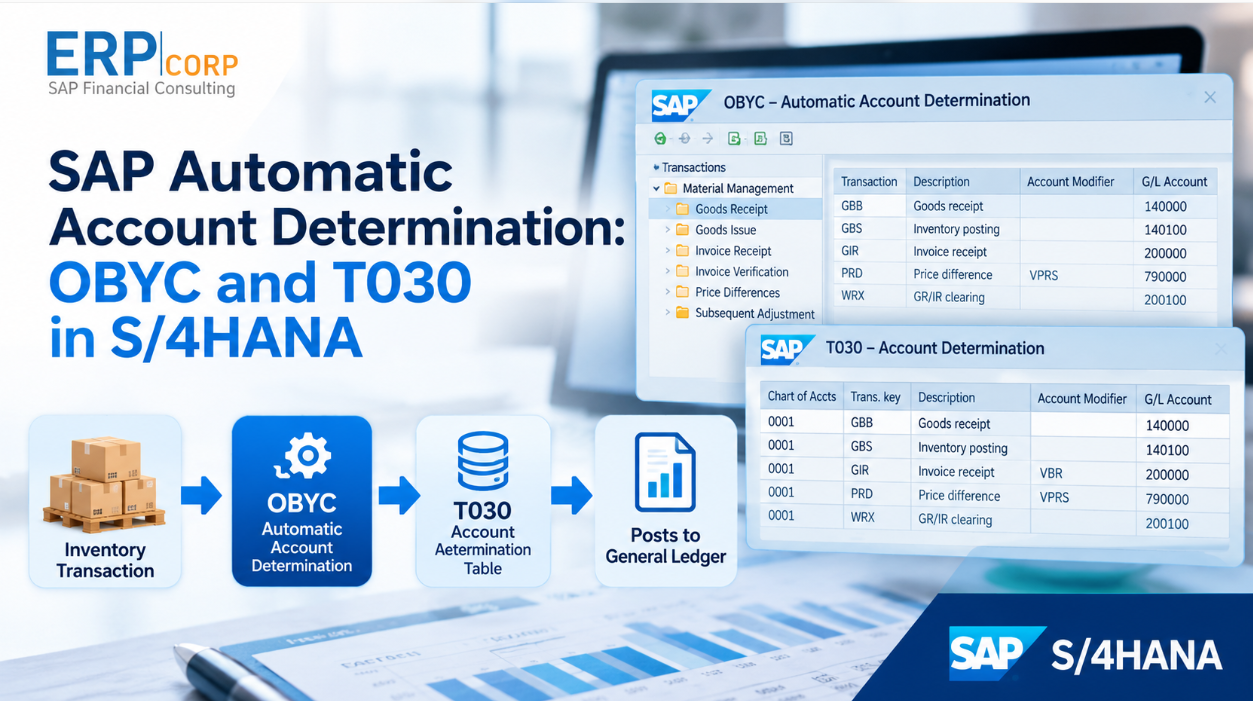
In SAP S/4HANA, automatic account determination controls which General Ledger (G/L) accounts are posted when inventory movements occur in Materials Management (MM). Correct account determination is essential for accurate inventory valuation, production cost reporting, and integration between Materials Management and Financial Accounting (FI).
A common question is how to identify the G/L account that SAP automatically selects for a particular goods movement. For example, when raw materials are issued to a production order, SAP uses account determination settings to identify the inventory account and the corresponding consumption account.
In SAP ECC and SAP S/4HANA on-premise and Private Edition, OBYC provides the configuration for MM automatic account determination, and T030 stores the relevant G/L account assignments. With the required display authorization, SE16N lets you review these entries without changing them.
This guide walks through a T030 lookup for GBB/VBR, explains how to read the results, and checks them against a goods issue to a production order. For the broader configuration logic and movement-type posting examples, see our SAP MM-FI account determination guide.
Read more: SAP OBYC Account Determination: T030 and SE16N Guide
- Hits: 49762
By Tom King

SAP Fiori apps help manufacturing teams compare actual and target costs, investigate production-order differences, and analyze performance by work center and operation. This article explains Production Cost Analysis (F1780) and Analyze Costs by Work Center/Operation (F3331).
2026 editorial note: Tom King’s original 2021 screenshots and walkthrough are preserved below. App availability, filters, and supported costing scenarios depend on your SAP S/4HANA edition and release. Distinguish analytical cost differences from posted WIP and settlement variances, especially when using event-based production accounting.
Read more: SAP Fiori Apps for Manufacturing Variance Analysis
- Hits: 26220
By John Jordan

SAP assembly scrap is a planned allowance for expected manufacturing losses. In SAP S/4HANA, it can increase the production quantity and dependent component requirements needed to deliver a required yield. Material costing uses the relevant scrap settings when calculating planned component and activity quantities.
This guide explains the classic material-master assembly scrap setting, its effect on a 100-PCB example, where to maintain it in MM02, and how to review the resulting cost estimate. For the broader costing process, see our S/4HANA Product Cost Controlling guide.
- Hits: 23123
By Anand Seetharaju, CPA, CMA

An attributed profitability segment adds market segment characteristics to a journal entry when its true account assignment is another object, such as an internal order or project. In SAP S/4HANA Margin Analysis, this enables earlier analysis by customer, product, brand, or other supported dimensions using information available when the posting is created.
Attribution helps explain costs before period-end settlement, but it does not turn the original posting into a true account assignment to a profitability segment. This guide explains the distinction, the classic configuration, a WBS example, and the reporting and release checks needed to use the results correctly.
- Hits: 67659
By John Jordan

SAP subcontracting is a procurement process in which a company provides components to an external vendor that manufactures or processes a finished or semi-finished material. In SAP S/4HANA, the components are managed as stock provided to the vendor, and their consumption is recorded when the subcontracted material is received.
Subcontracting connects purchasing, inventory management, Material Requirements Planning (MRP), and product costing. For example, a manufacturer can supply components to a subcontractor, create a subcontracting purchase order using transaction ME21N, and record the finished material's goods receipt while accounting for the components consumed.
In this article, we'll explain how subcontracting works in SAP, how overhead and special procurement settings affect the process, and how outsourced manufacturing relates to material costing.
Read more: SAP Subcontracting in S/4HANA: Process, MRP, and Costing
- Hits: 18171
By John Jordan
The SAP actual cost component split shows the composition of actual material costs by categories such as material, labor, and overhead. It retains the origin of costs across production levels, helping you explain how lower-level costs contribute to semi-finished and finished products.
It complements Actual Costing with SAP Material Ledger by adding component detail to material cost analysis. This guide covers classic activation and display steps, release-specific startup considerations, and the distinction between costing-based CO-PA and Margin Analysis reporting.
Read more: SAP Actual Cost Component Split: Setup and Reporting
- Hits: 40612
By John Jordan

Introduction
SAP S/4HANA provides several methods for allocating overhead costs to products and manufacturing orders. Common approaches include activity rates, template allocation, and costing sheets.
Read more: SAP Costing Sheets in S/4HANA: How to Allocate Overhead

- Hits: 46329
By John Jordan
Actual Costing in SAP Material Ledger enables organizations to calculate the actual cost of materials by collecting and allocating price differences incurred during a period. These differences can arise from purchase price variances, production variances, and other inventory-related transactions.
At period-end, Actual Costing calculates a periodic unit price (PUP) that reflects the actual costs of procuring and producing materials. This provides greater transparency into material costs, inventory valuation, and cost of goods sold.
- Hits: 40968
By John Jordan
Table of Contents
- Introduction
- No Period-End Processing
- Single-level price determination
- Multiple-level price determination
- Glossary
Introduction
The three period-end options when you activate SAP Material Ledger are:
- No Actual Costing - no period-end processing
- Single-level price determination
- Multilevel price determination
Here's more details of each option: