
By Kent Bettisworth and Gerald Steele

SAP Internal Orders and Work Breakdown Structure (WBS) elements are both used to plan, collect, monitor, and control costs in SAP S/4HANA. However, they serve different purposes. Internal Orders are generally suited to simpler, short-term cost tracking, while WBS elements in SAP Project System support more complex projects with hierarchical structures, schedules, budgets, and detailed project reporting.
Understanding the differences is essential in optimizing projects. This blog compares Internal Orders and Project System WBS by exploring their definitions, benefits, features, and implementation tips.
Table of Contents
Introduction
Internal Orders provide a relatively simple way to collect and monitor costs for specific activities, initiatives, or short-term projects. WBS elements, part of SAP Project System (PS), provide a hierarchical structure for planning and controlling more complex projects involving multiple phases, activities, budgets, and responsibilities.
Definitions
An Internal Order is a Controlling (CO) cost object used to plan, collect, monitor, and settle costs for a specific activity or purpose. Internal Orders are commonly used for short-term initiatives, events, maintenance activities, marketing programs, and other costs that need to be tracked separately.
A Work Breakdown Structure (WBS) organizes a project into hierarchical elements representing phases, deliverables, tasks, or other project components. In SAP Project System (PS), WBS elements can be used to plan, budget, collect, and report costs at different levels of the project structure.
Benefits
Internal Orders provide a straightforward way to monitor costs for specific activities without creating a full project structure. They support planning, budgeting, actual cost tracking, variance analysis, and settlement, giving managers visibility into the financial performance of individual initiatives.
For a step-by-step budgeting example, see: SAP Internal Order Budgeting and Availability Control.
WBS elements provide structured control for complex projects by organizing costs, revenues, budgets, and responsibilities within a hierarchy. They support detailed planning and reporting across project phases and make it easier to analyze financial performance at individual WBS levels or across the entire project.
Comparison
1. Structure and Hierarchy
- Internal Order: A cost object that does not follow a hierarchical structure. It typically tracks costs and revenue for a specific activity or project.
WBS elements follow a hierarchical structure, breaking the project scope into smaller, manageable components. It provides a clear overview of project deliverables and dates, including detailed tasks, subtasks, and their relationships.
2. Cost Control and Monitoring
- Internal Order: Provides a single charge code allowing cost tracking and monitoring. Costs can be charged to specific internal orders and later allocated or settled to cost centers, enabling accurate analysis of project-driven expenses compared to ongoing operational cost center costs.
WBS: Each WBS element can serve as an account assignment object for directly collecting costs and revenues. However, WBS is better utilized to provide a framework for more detailed cost estimation and control at the lower level WBS or networks. Breaking down the project into smaller components (network activities) makes it easier to estimate costs, plan requisitions and purchase commitments, monitor budget utilization, and schedule accurate delivery dates.
3. Resource Allocation and Planning
- Internal Order: Does not provide a direct mechanism for resource allocation, planning, or scheduling beyond simple start and end dates. However, it can be used with other SAP modules, such as purchasing, to track commitments and actual costs based on 3-way matches and manage basic logistics effectively.
- WBS: Supports resource allocation and planning by organizing the project into WBS elements, networks, and activities with planned dates and resource requirements.
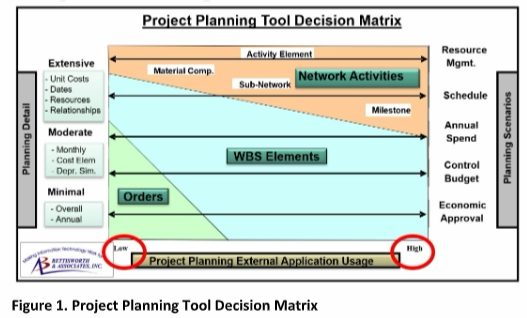
The Project Planning Tool Decision Matrix helps you choose between an Internal Order and WBS elements based on project complexity, planning requirements, scheduling needs, and integration with external project management applications, as shown in Figure 1.
4. Reporting and Analysis
Internal Order: Supports reporting on planned and actual costs, commitments, budgets, and variances for individual orders or groups of orders. This provides visibility into spending and financial performance for the activities being tracked.
WBS: Supports detailed reporting across the project hierarchy, allowing costs, revenues, commitments, budgets, and project progress to be analyzed at individual WBS levels or across the entire project. This provides greater visibility and control for complex, multi-phase projects.
Integration with Other Modules
Internal Order: It integrates with several modules, including Controlling (CO), Financial Accounting (FI), Purchasing (MM), and Investment Management (IM). This enables an integrated view of project costs, budget allocations, commitments, and financial performance.
WBS: Integrates with SAP Controlling (CO), Financial Accounting (FI), Materials Management (MM), Sales, Procurement, Asset Accounting, Plant Maintenance, and other SAP processes. This integration allows project costs, revenues, commitments, assets, and operational activities to be managed within a common project structure.
Practical Tips and Tricks
Choosing between Internal Orders and WBS elements depends on the complexity, duration, reporting, and planning requirements of your project. Consider these practical guidelines:
1. Clearly define project scope and objectives before deciding which project type to use: Internal Orders or WBS. This clarity will help structure projects appropriately and select the most suitable approach and tool.
2. Involve key stakeholders, including team members, sponsors, and clients, in the design and implementation process to ensure alignment with organizational goals. Their input and feedback will help select the most appropriate project management approach and SAP project concept and secure buy-in from all parties involved.
3. Regularly monitor and update the chosen project tool, either Internal Orders or WBS, to reflect changes in project requirements. Continuously review and update each as the project progresses. This will help you identify and mitigate potential risks and ensure the project remains on track.
4. Train project team members to use the Internal Order and WBS tools to maximize the benefits.
5. Leverage available SAP resources, such as user manuals, company experts, and online forums, to enhance your understanding and proficiency in using these tools.
6. Reporting and Analytics: Understand and utilize the available reporting and analytics capabilities of Internal Orders or Project System WBS to gain insights into project performance, budget capacity, resource utilization, and cost control. This data-driven approach will enable informed decision-making and initiative-driven project management.
Summary
Internal Orders and WBS elements both provide powerful ways to plan, monitor, and control project-related costs in SAP S/4HANA. Internal Orders are generally better suited to simpler, short-term activities requiring focused cost tracking, while WBS elements provide the hierarchical structure, planning capabilities, and reporting needed for more complex projects.
Choosing between them depends on the project's complexity, duration, budgeting, scheduling, integration, and reporting requirements.
Need Help with SAP Controlling?
ERPCorp helps companies optimize SAP Controlling, Internal Orders, Project System integration, and S/4HANA Finance processes.
Explore SAP Consulting Services
Network with our expert speakers and attendees at our annual SAP Controlling Financials conference in San Diego.
Glossary
Accrual Order
An Accrual Order is an Internal Order used to collect and monitor period-related accruals in SAP Controlling.
Cost Center
A Cost Center is an organizational unit used to collect and monitor costs for a defined area of responsibility. Unlike an Internal Order or WBS element, a cost center typically represents an ongoing organizational function.
Fixed Assets
Fixed Assets are long-term tangible assets, such as buildings, machinery, and equipment. Investment-related costs collected on Internal Orders or WBS elements may subsequently be capitalized and settled to fixed assets.
Internal Order
An Internal Order is a Controlling (CO) cost object used to plan, collect, monitor, and settle costs for specific activities or purposes. Internal Orders are often used when the scope does not require the more detailed project structure available with WBS elements.
Order Type
Order Type controls key settings for Internal Orders, including number assignment, status management, planning parameters, and settlement behavior.
Periodic Reposting
Periodic Reposting is used in SAP Controlling to periodically reallocate collected costs from one cost object to other cost objects based on defined rules or statistical key figures.
SAP Fiori
SAP Fiori provides role-based applications for accessing and managing SAP S/4HANA processes. Depending on system configuration and available apps, users can perform Controlling and Project System activities and analyze financial information through the SAP Fiori launchpad.
SAP Universal Journal
SAP Universal Journal provides a single source of financial and management accounting data in SAP S/4HANA. Actual postings are stored in ACDOCA, enabling integrated reporting across Financial Accounting, Controlling, and related processes.
Settlement
Settlement transfers costs collected on an Internal Order or WBS element to one or more receiver objects according to defined settlement rules.
Settlement Profile
Settlement Profile defines the rules and parameters that control settlement, including permitted receiver types and settlement options.
Settlement Rule
Settlement Rule defines how costs collected on an Internal Order or WBS element are distributed to one or more receiver objects during settlement.
Source Cost Element
Source Cost Element identifies the original cost element from which costs are allocated or settled in SAP Controlling, helping retain information about the nature of the original costs.
Statistical Key Figure
Statistical Key Figure is a measurable value, such as number of employees, square footage, or machine hours, that can be used as a basis for allocating costs in SAP Controlling.
Statistical Order
A Statistical Order is an Internal Order used for additional reporting and analysis while the actual cost is posted to another real cost object, such as a cost center. Statistical Orders do not receive real costs and are not subsequently settled.
Tracing Factor
Tracing Factor defines how costs are distributed among receiver objects during periodic allocations in SAP Controlling. Examples include statistical key figures, percentages, fixed amounts, or other allocation bases.
Variance Analysis
Variance Analysis compares planned or budgeted costs with actual costs to identify and analyze differences. Internal Orders and WBS elements can both be used to monitor costs and analyze variances during an activity or project.
WBS Element
A WBS Element is a structural component of a Work Breakdown Structure in SAP Project System used to organize, plan, collect, and monitor costs and other project information. WBS elements are useful when activities require a more detailed hierarchical project structure than an Internal Order provides.