
by John Jordan

Introduction
In SAP S/4HANA, automatic account determination controls which General Ledger (G/L) accounts are posted when inventory movements occur in Materials Management (MM). Correct account determination is essential for accurate inventory valuation, production cost reporting, and integration between Materials Management and Financial Accounting (FI).
A common question is how to identify the G/L account that SAP automatically selects for a particular goods movement. For example, when raw materials are issued to a production order, SAP uses account determination settings to identify the inventory account and the corresponding consumption account.
Transaction OBYC is used to configure automatic account determination, while table T030 stores the relevant G/L account assignments. You can display these settings using transaction SE16N, even when you do not have authorization to change the configuration in OBYC, provided you have the necessary table-display access.
In this article, we explain how to display and analyze SAP automatic account determination entries using OBYC, T030, transaction key GBB, account modifier VBR, and valuation class. We also demonstrate how these settings help determine the G/L accounts used when materials are issued to production orders.
Table of Contents
Display SAP OBYC Account Determination with T030 and SE16N
End users typically do not have authorization to access configuration Transaction OBYC. However, you can display the underlying automatic account determination settings in table T030 using Transaction SE16N.
To display the automatic account determination settings, enter table T030 in Transaction SE16N.
Enter table T030 and press Enter to display the selection screen shown in Figure 1.

Figure 1: SAP T030 Selection Screen for OBYC Automatic Account Determination
Use the Selection Criteria to identify the G/L accounts assigned to specific MM transactions. To display the G/L accounts posted during goods issues to production orders, enter the following values:
- Chart of Accounts: Enter the chart of accounts used by the company code. In this example, the chart of accounts is INT.
- Transaction Key: Enter GBB (Offsetting Entry for Inventory Posting). GBB is used for several types of inventory offsetting entries.
- Valuation Grouping Code: Enter the valuation grouping code assigned to the valuation area. In this example, the value is 0001.
- Account modifier: Enter VBR for goods issues to production orders. The account modifier further differentiates account determination within transaction key GBB.
- Valuation Class: Enter the material's valuation class. The valuation class links materials with similar account determination requirements to the appropriate G/L accounts.
Click Execute to display the automatic account determination entries shown in Figure 2.
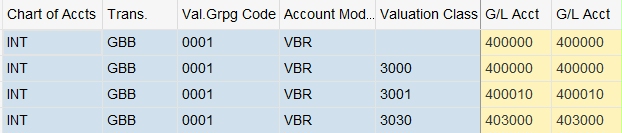
Figure 2: SAP T030 Entries for GBB/VBR Automatic Account Determination
The T030 entries show the G/L accounts automatically determined for goods issues to production orders based on the valuation class.
Example: Automatic Account Determination for Goods Issue to a Production Order
Consider a manufacturing company that issues raw materials to a production order using movement type 261.
Assume the following example:
- Material: Raw Material A
- Quantity issued: 100 units
- Inventory valuation price: $25 per unit
- Total goods issue value: $2,500
- Valuation class: 3000
- Transaction key: GBB
- Account modifier: VBR
When the goods issue is posted, SAP reduces raw material inventory and records the material consumption against the production order.
Example Accounting Entry
| G/L Account | Debit | Credit |
|---|---|---|
| Raw Material Consumption | $2,500 | |
| Raw Material Inventory | $2,500 | |
| Total | $2,500 | $2,500 |
In this example, transaction key BSX determines the inventory G/L account, while GBB with account modifier VBR determines the consumption G/L account.
SAP uses the relevant valuation area, valuation grouping code, chart of accounts, and material valuation class to identify the configured G/L accounts.
You can use transaction SE16N to display table T030 and verify which G/L account is assigned to the GBB/VBR combination for the applicable valuation class.
This example illustrates how SAP MM-FI automatic account determination supports consistent financial postings without requiring users to enter the G/L accounts manually for each goods movement.
Note: The values and G/L account descriptions are illustrative. Actual account assignments depend on your organization's SAP configuration.
More Information
To configure SAP automatic account determination, follow the IMG menu path:
Materials Management › Valuation and Account Assignment › Account Determination › Account Determination Without Wizard › Configure Automatic Postings
Figure 3 displays the menu path.
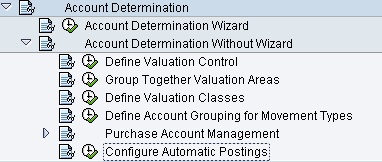
Figure 3: Configure Automatic Postings Menu Path
Click the paper and glasses icon to the left of Configure Automatic Postings at the bottom to display SAP documentation on setting up automatic postings.
OBYC vs. T030 in SAP
Transaction OBYC is used to configure automatic account determination for Materials Management transactions. The configuration is stored in table T030, which contains the transaction keys, account modifiers, valuation classes, and associated G/L accounts used for automatic postings.
Use OBYC when you have authorization to configure automatic account determination. Use SE16N with table T030 when you want to display and analyze the underlying account determination entries.
Need Help with SAP S/4HANA Finance and Controlling?
ERPCorp helps companies optimize SAP Product Costing, Controlling, automatic account determination, and S/4HANA Finance processes.
Explore SAP Consulting Services
Glossary
Goods Issue
A goods issue is the movement (removal) of goods or materials from inventory to manufacturing or to a customer. When goods are issued, the amount of stock in the warehouse is reduced.
Goods Receipt
It is a goods movement used to post goods received from external vendors or from in-plant production. All goods receipts increase stock in the warehouse.
Standard Price
The standard price in the Costing 2 view determines the inventory valuation price if price control is set at standard (S). The standard price is updated when a standard cost estimate is released. You normally value manufactured goods at the standard price.
Material Master
A material master contains all of the information required to manage a material. Information is stored in views, and each view corresponds to a department or area of business responsibility. Views conveniently group information together for users in different departments, for example, sales and purchasing.
Price Control
The Price control field in the Costing 2 view determines whether inventory is valuated at standard or moving average price.
Production Order
A production order is used for discrete manufacturing. A BOM and routing are copied from master data to the order. A sequence of operations is supplied by the routing, which describes how to carry out work-steps.
An operation can refer to a work center at which it is to be performed. An operation contains planned activities required to carry out the operation. Costs are based on the material components and activity price multiplied by a standard value.
Purchase Price Variance
When raw materials are valued at the standard price, a purchase price variance will post during goods receipt if the goods receipt or invoice price is different from the material standard price.
SAP Fiori
SAP Fiori provides role-based applications for SAP S/4HANA. The Automatic Account Determination app can be used to maintain G/L account assignments for automatic postings.
Valuation Class
The valuation class groups materials for automatic account determination and helps determine which G/L accounts are posted during inventory transactions. It is used with transaction keys such as GBB in SAP automatic account determination.
Valuation Grouping Code
The valuation grouping code groups valuation areas for automatic account determination, allowing multiple plants to use the same G/L account assignments. It is configured using Transaction OMWD and used in OBYC account determination.