
Based on a SAP Controlling Conference presentation by Dawn Watts and Rogerio Faleiros.
SAP Material Ledger in S/4HANA provides the inventory valuation foundation for understanding material costs. Moving from that foundation to Actual Costing requires decisions about master data, period-end processing, and the reporting your finance team needs.
In their presentation, “Mastering the Material Ledger Journey in SAP S/4HANA,” Dawn Watts and Rogerio Faleiros describe the progression as crawl, walk, run, fly. This article uses that framework to explain what to prepare, which decisions to make, and how to build confidence before expanding your use of Actual Costing.
Table of Contents
- Material Ledger vs. Actual Costing
- The Crawl, Walk, Run, Fly Roadmap
- Why Activate Actual Costing?
- Plan Your Activation Approach
- Prepare Data and Validate the Conversion Approach
- Check Price Determination and Price Control
- Extend Reporting and Valuation
- Key Takeaways
- Watch the Conference Session
- Glossary

Material Ledger vs. Actual Costing
Material Ledger is mandatory for inventory valuation in SAP S/4HANA. Actual Costing remains optional. Establishing the Material Ledger foundation and deciding to run Actual Costing are separate parts of the implementation plan.
Material Ledger supports inventory valuation in configured currencies and valuation views. A currency answers “In which currency is the value expressed?” A valuation view addresses the perspective used to value the inventory, such as legal or group valuation. These are different design decisions.
Actual Costing calculates period-end material costs by allocating relevant price differences. It can support inventory revaluation and consumption revaluation, depending on the closing settings. It requires an operational closing process as well as configuration.
For the foundations, see SAP Material Ledger in S/4HANA: Overview and Actual Costing.
The Crawl, Walk, Run, Fly Roadmap
The stages in Table 1 provide a practical way to organize the journey. They are a planning framework, rather than SAP configuration statuses.
| Stage | Focus | Evidence of readiness |
|---|---|---|
| Crawl | Understand the valuation foundation. | Agree on currencies, valuation views, reporting goals, and responsibilities. |
| Walk | Prepare master data and reconcile balances. | Resolve material-data issues and document a tested startup or conversion plan. |
| Run | Execute repeatable Actual Costing closes. | Explain price differences, review results, and reconcile the accounting postings. |
| Fly | Use the results for deeper cost and profitability analysis. | Connect material cost detail to business decisions and extend valuation capabilities where justified. |
Why Activate Actual Costing?
Standard costs give your team a baseline. Actual Costing helps explain how procurement and production differences affect material costs across the supply chain. At period-end, the calculated periodic unit price (PUP) provides an actual-cost measure for analysis and the configured revaluation processes.
Start with a business question: Do you need to understand the cost impact of purchase price changes, follow differences through multiple production levels, or improve the detail behind inventory and consumption valuation?
Agree on whether the project will calculate costs for analysis, post inventory revaluation, and include consumption revaluation. These decisions affect testing, reconciliations, and how users interpret profitability reports.
Figure 2 shows Dawn Watts presenting at the conference. For a technical companion to this roadmap, read Actual Costing with SAP Material Ledger.

Plan Your Activation Approach
Coordinate the work across Finance, Controlling, Materials Management, Manufacturing, and the technical team. Consider three approaches:
- Introduce Actual Costing in ECC before conversion. This can give the team operating experience, but adds a project in the source landscape and requires a conversion plan for the existing costing data.
- Establish S/4HANA Material Ledger and introduce Actual Costing later. This separates the work into phases, with a defined later activation and testing effort.
- Introduce Actual Costing as part of the S/4HANA implementation. This aligns the business design, but broadens implementation and closing-test scope.
Select the approach based on business readiness, the conversion path, and available resources. Estimate effort and downtime from system-specific assessments and rehearsals. A single duration does not apply to every landscape.
Prepare Data and Validate the Conversion Approach
Use a documented readiness checklist before startup or conversion:
- Reconcile inventory quantities and values between logistics and accounting.
- Investigate aged GR/IR balances and incomplete purchasing transactions. Make corrections according to the underlying business documents.
- Review open production orders, work in process, and settlement status. Close orders when their business processing is complete.
- Check material valuation settings, relevant plants, currencies, and the reporting design.
- Rehearse the applicable startup or conversion process and reconcile the results.
CKMSTART is associated with Material Ledger production startup. It is not a general S/4HANA conversion tool. SAP's installation documentation identifies separate conversion steps and a dedicated procedure for subsequent Actual Costing activation. Follow the procedure applicable to your release and starting point.
See SAP's Actual Costing/Material Ledger installation guidance when planning the technical sequence.
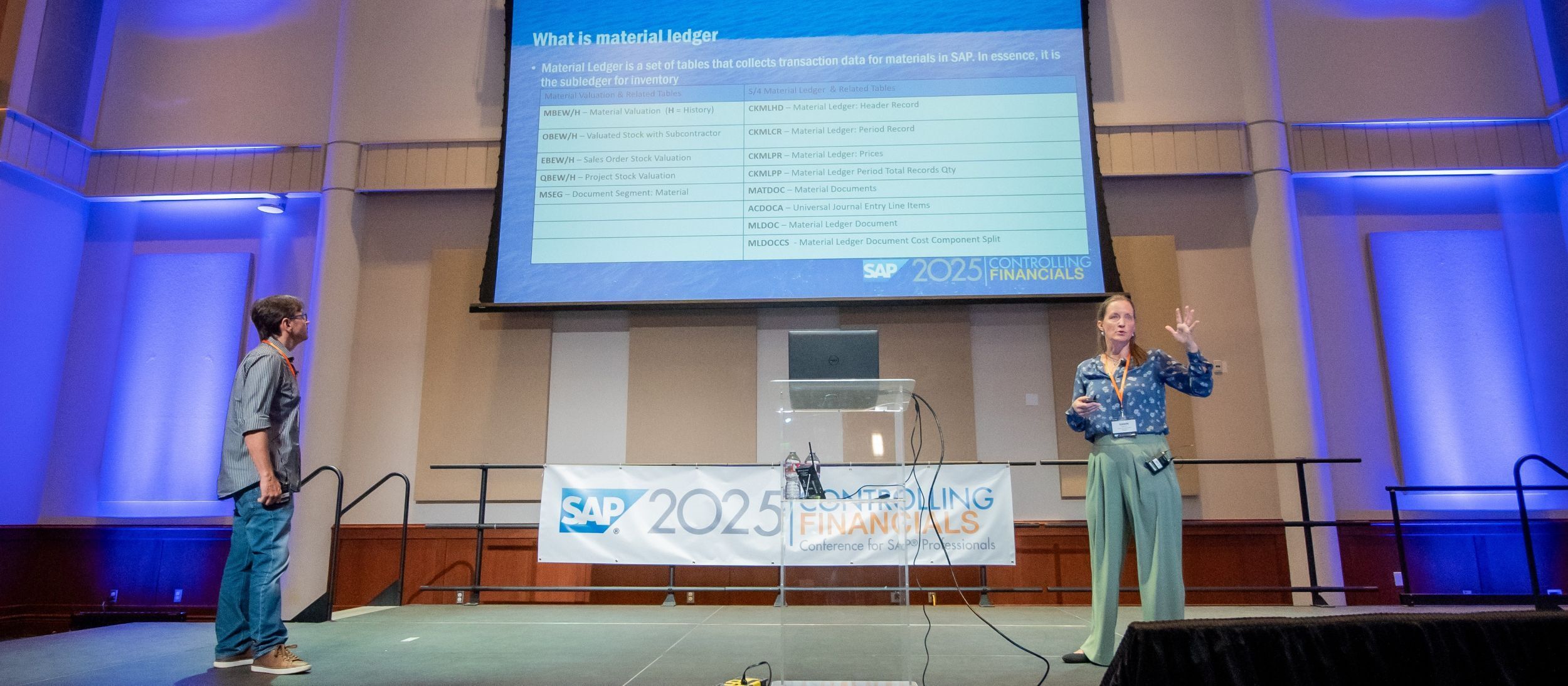
The conference presentation connects these preparation decisions to the wider Material Ledger journey, as illustrated by the presenters in Figure 3.

Check Price Determination and Price Control
For materials participating in single-level and multilevel Actual Costing, use Price Determination 3 with Price Control S. Transaction CKMM changes the relevant material settings; changing the material alone does not activate Actual Costing for the plant.
A material currently using moving average price can be included in the design after the required change to standard price control. Review the timing and prerequisites before changing settings in production. SAP advises against switching materials to Price Determination 3 when Actual Costing is not active.
For details, see SAP's material price determination guidance and ERPCorp's Standard Price vs. Moving Average Price article.
Extend Reporting and Valuation
Once the close is repeatable and reconciled, use the results to investigate procurement and manufacturing cost differences. The “fly” stage is about applying cost information to decisions.
- Analyze how relevant differences affect raw materials, semifinished products, and finished goods.
- Review inventory and consumption revaluation against the agreed accounting design.
- Connect cost detail to profitability reporting, with clear treatment of variances and revaluation amounts.
- Evaluate additional valuation and reporting requirements as separate design decisions.
Multiple currencies and valuation views are not benefits that become available only when Actual Costing is enabled. Likewise, legal, group, and profit center valuation should not be treated as interchangeable with accounting principles or ledger design.
For related reporting topics, see SAP COGS Split in S/4HANA and SAP Variance Split in S/4HANA.
Key Takeaways
- Separate the decisions. Material Ledger provides the S/4HANA inventory valuation foundation; Actual Costing adds period-end actual-cost calculation.
- Define the business result. Agree on the reporting and revaluation outcomes before configuring the solution.
- Prepare and reconcile. Treat master data, open transactions, and conversion testing as part of the project.
- Build a repeatable close. Confirm that users can explain differences and reconcile postings before expanding scope.
Figure 4 shows the presenters on stage. Continue the discussion through the conference recording and ERPCorp's technical learning content.
Continue Your Material Ledger Journey
Explore the full presentation, Mastering the Material Ledger Journey in SAP S/4HANA, by Dawn Watts and Rogerio Faleiros, along with more expert SAP Finance and Controlling learning content.
ERPCorp membership provides access to conference session recordings so you can continue learning beyond this article.
Need help applying this to your SAP landscape? Explore ERPCorp Material Ledger and Actual Costing consulting for configuration reviews, cost analysis, and period-end process improvement.
Glossary
Actual Costing
An optional Material Ledger function that allocates relevant price differences to calculate actual material costs at period-end.
Consumption Revaluation
The adjustment of eligible consumption values using Actual Costing results, according to the configured closing process.
Inventory Revaluation
An adjustment to ending inventory value based on Actual Costing results and the selected closing options.
Material Ledger
SAP's inventory valuation component, supporting configured currencies and valuation views. It is mandatory for inventory valuation in SAP S/4HANA.
Periodic Unit Price (PUP)
The material unit cost calculated for a period using relevant preliminary values and allocated price differences.
Price Control
The material valuation setting identifying standard price (S) or moving average price (V). Participating Actual Costing materials use standard price for preliminary valuation.
Price Determination
The material setting distinguishing transaction-based determination (2) from single-level and multilevel determination (3).
Valuation View
The valuation perspective used for inventory, such as legal, group, or profit center valuation, according to the system's accounting design.